Olena Fomenko

Breaking Gender Barriers
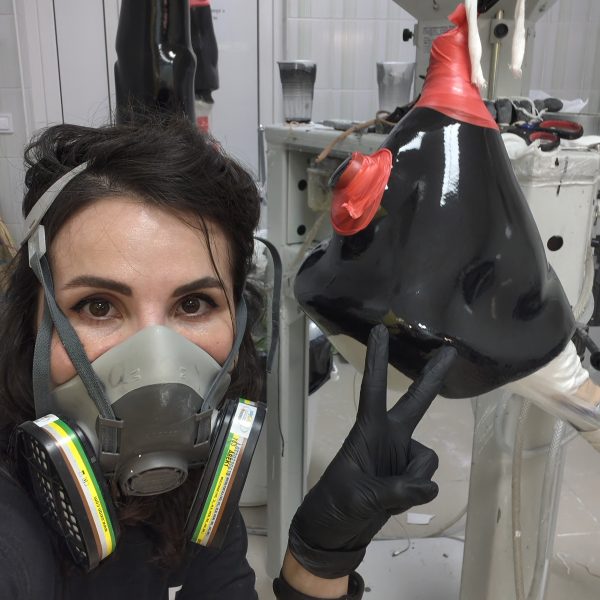
A woman wearing a respirator mask and black gloves poses for a selfie in a workshop, pointing at a black, cone-shaped object covered in red plastic wrap.

The woman, positioned in the foreground on the left side of the frame, has dark hair and wears a grey respirator mask. The mask covers her nose and mouth, and it has prominent filters attached to the sides. She wears black, form-fitting gloves, and her left hand is raised, with two fingers extended in a peace sign, pointing towards the object. A black bracelet is visible on her right wrist. She is wearing a black t-shirt.

The main subject of the image, besides the woman, is the black, glossy, cone-shaped object. It appears to be made of a hard material and is partially covered with bright red plastic wrap, particularly at its upper section and a smaller protrusion near what might be considered its base. Two white ropes hang from the top of the object. The object is suspended or mounted on some sort of equipment, visible behind it.

The setting appears to be a workshop. The background consists of white tiled walls and some industrial-looking equipment. To the left, a white door with vertical lines is visible. On a surface behind the object, there are some disposable cups, one of which is grey and appears to have paint or residue inside. Other tools or materials are scattered around, suggesting work in progress. The overall atmosphere is practical and focused on the task at hand, with the woman’s direct gaze and gesture adding a touch of personal engagement to the scene.

I chose a profession I was once told was ‘not for women,’ and I have never looked back.

My journey began in the quiet of an office, working with documentation and administrative tasks, but my attention was always drawn elsewhere. I found myself watching the workshop for hours, fascinated by the way measurements, materials, and technical skill came together to help someone walk again. I knew I wanted to be part of that process. I had the passion, but I lacked a pathway from observation to practice.

For a long time, I believed the message I heard around me: that prosthetics and orthotics was a profession better suited to men. That belief became an internal barrier. I explored other directions, including physical therapy, but I still felt as though I was standing on the sidelines of the profession that truly inspired me.

Human Study became the bridge I had been looking for.

The program gave me far more than technical knowledge. It gave me professional recognition and the confidence to step into the workshop as an equal. The transition was not easy. Moving from office work into technical practice meant learning physically demanding skills such as casting, moulding, and fabrication. But Human Study taught me that excellence in prosthetics is not defined by physical strength. It is defined by precision, critical thinking, and a deep understanding of the human body.

Before this education, I relied largely on intuition and experience. Today, I understand the biomechanics and anatomy behind every decision I make. I have moved from trial and error to evidence-based practice. Every adjustment is guided by clinical reasoning, helping me ensure that a prosthesis works in harmony with the person who uses it.

The true value of this education became clear when I worked with my first patient. He was a soldier recovering from a mine explosion, physically injured and emotionally exhausted. It was the kind of case that would once have overwhelmed me. In the past, I might have felt pressured by his desire to walk again as quickly as possible, or uncertain about how to approach the complexity of his condition.

A woman in a grey scrub suit is applying plaster to a cast of a human torso. She is wearing blue latex gloves and is using her hands to smooth the plaster onto the cast, which is mounted on a stand. The cast has blue markings on it. In the background, there are shelves filled with various items, including buckets, tools, and what appear to be more casts. A large green bin is also visible. The room has tiled walls and a window with frosted glass. The overall atmosphere is one of purposeful work in a clinical or workshop setting.
The image shows a woman in a workshop, holding a prosthetic limb. She is wearing a black t-shirt with a white logo and a white hairnet. The prosthetic limb is dark gray and appears to be made of a composite material. It consists of a socket and a lower shaft. The woman is smiling and looking at the camera. The background of the image is a workshop environment. To the left, there are some machines and equipment, including what looks like a stand with some cylindrical objects. A partial view of another person's arm and hand can be seen on the far left, possibly working on something. The wall behind the woman is white and there is a ceiling with fluorescent lighting. In the foreground, on a textured workbench, there are several objects. These include a metallic fitting on the left and some white and gray components of what might be other prosthetics or related equipment on the right. The workbench itself is cluttered with various materials, possibly remnants of the prosthetic fabrication process, such as small yellow and white specks. The composition is a close-up shot, with the woman occupying a significant portion of the frame. She is positioned slightly off-center to the right, and the prosthetic limb is held up in the left part of the frame, creating a balanced diagonal line. The perspective is from a slightly low angle, looking up at the woman. The focus is sharp on the woman and the prosthetic limb she is holding, with the background slightly blurred. Subtle details include the texture of the prosthetic limb's socket, which appears to be woven carbon fiber, and the details on the various fittings on the workbench.

Instead, I relied on the structured clinical approach I had learned through Human Study. Anxiety gave way to a clear process. I remember telling him, “Give yourself time.” Before, those words would have been simple encouragement. Now they reflected a professional understanding of rehabilitation. I explained the biomechanics behind his alignment and showed him that achieving the right fit is not a race, but a careful process of assessment, testing, and adjustment.

Together, we worked through the dynamic alignment process until the prosthesis functioned exactly as it should. When he took his first confident steps, it was more than a technical success. It was a personal victory for both of us.

Today, I am no longer simply the person helping behind the scenes. I am a prosthetics and orthotics professional whose knowledge is valued by colleagues across the country. I still feel deeply affected by the stories of the people we serve, especially children. But Human Study taught me how to transform those emotions into action. I learned that while sympathy alone changes little, professional knowledge and skills can become a powerful force for restoring mobility, dignity, and opportunity.